
Tabon Cave: Reading the Philippines’ Deep Past in Stone, Bone and Clay
In southern Palawan, Tabon’s discoveries reveal skilled hands and long human histories. The evidence is richer than a single story of “the first Filipino.”
A stone flake is not an obvious rival to a monument. It may have no inscription, no recognizable face and no date that a visitor can read without help. Yet the worn edge of a tool can preserve evidence of a person’s work long after the material they worked on has disappeared.
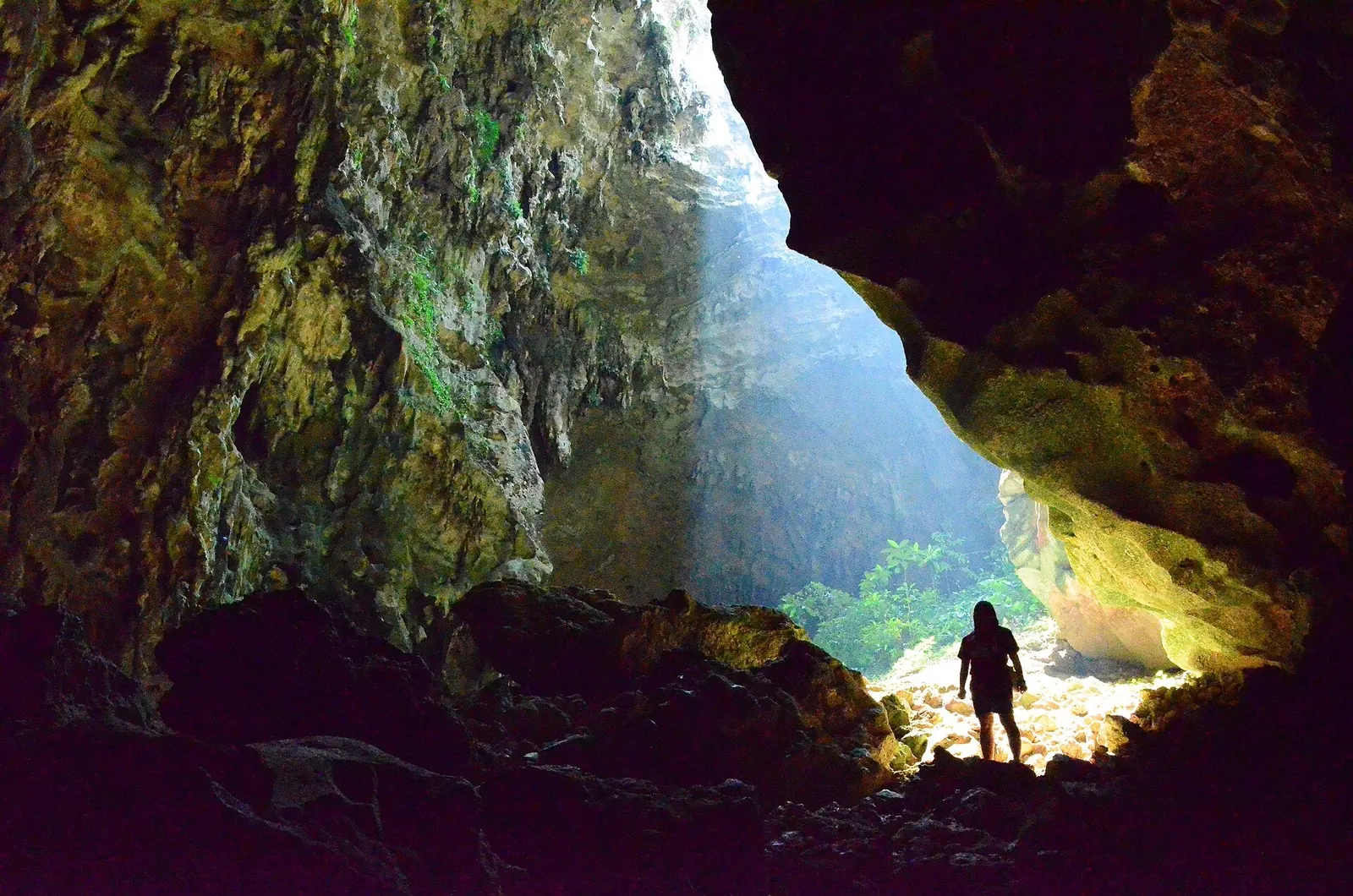
That is part of the importance of Tabon Cave and the surrounding Lipuun Point complex in southern Palawan. Human remains, tools and burial objects open windows onto different periods of life in the archipelago. Together they invite a larger question than who arrived first: what can we responsibly know about people whose world survives only in fragments?
First, place Tabon on the right map
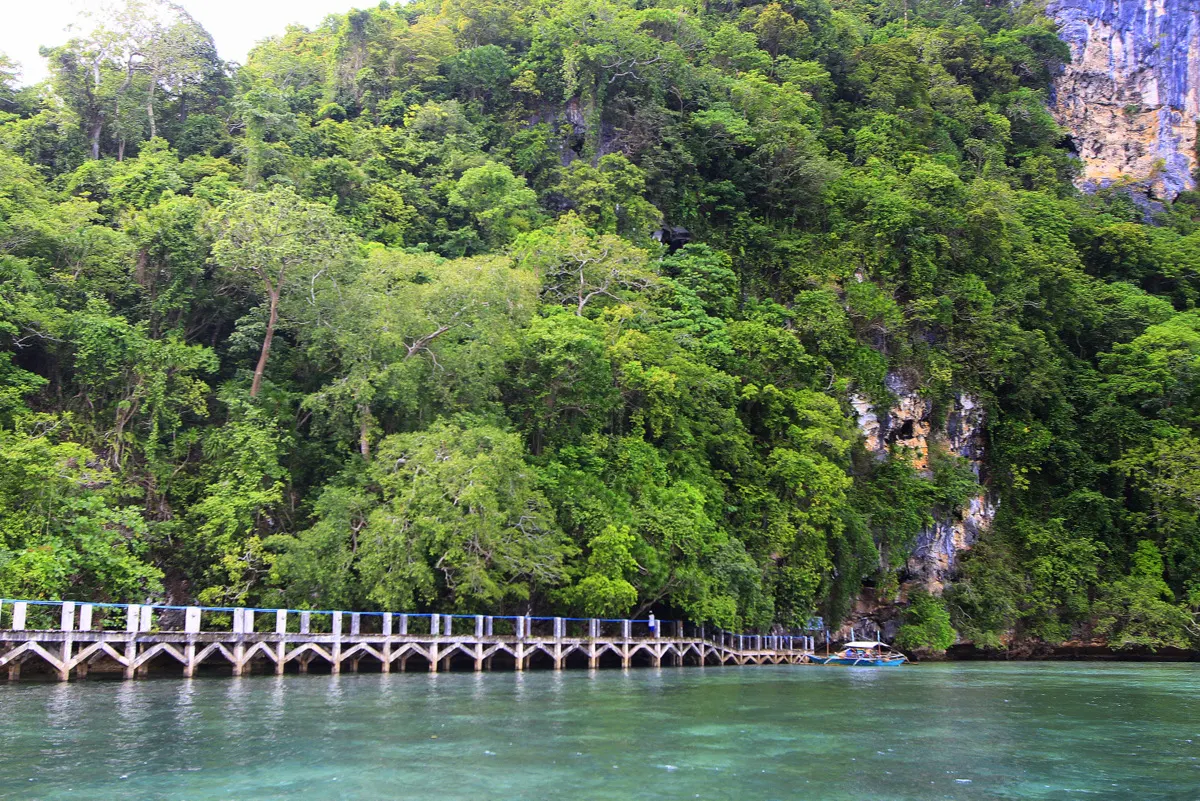
Tabon is in the municipality of Quezon, Palawan—not Quezon City in Metro Manila. The cave complex occupies Lipuun Point, in a landscape where limestone and forest meet the coast. It belongs to a different part of Palawan from the better-known Underground River near Sabang.
The National Museum’s overview records systematic excavation by a team led by Robert B. Fox from 1962 to 1965. The site later received protection as a museum reservation. Calling it a single cave can be misleading: Tabon is one named cave within a wider archaeological complex.
The difference matters when reading labels. An object found elsewhere on Lipuun Point should not automatically be described as a discovery from Tabon Cave itself. A shared landscape does not make every excavation location interchangeable.
A discovery with local knowledge behind it
Scientific histories often compress a discovery into the name of one archaeologist. The National Museum’s account of the research anniversary preserves an important part of the story: Pala’wan informants guided Fox and the museum team to the caves of Lipuun Point.
That acknowledgment changes the familiar image of an outsider finding an unknown place. The caves already existed within a landscape known to local people. Archaeological investigation brought particular methods and questions to it; it did not create the landscape’s history or erase the knowledge that helped researchers reach it.
Giving that contribution space is more than courtesy. It helps readers understand how knowledge is made: through guides, communities, field teams, laboratory work and later interpretation, rather than through one dramatic moment of revelation.
What does “Tabon Man” actually mean?
The phrase is memorable, but it can encourage the mistaken idea that a single complete skeleton answers every question. The record is more complicated.
A National Museum briefer on Tabon describes human fossils together with animal remains, hearth evidence and thousands of stone artifacts. It identifies a human tibia fragment dated by uranium-series methods to approximately 47,000 years ago. That is an estimate attached to a particular specimen and method, not a precise birthday for everyone who used the cave.
The UNESCO Tentative List dossier reports an uncertainty range around that tibia estimate and different ages for other human remains. It also lists the Tabon complex as a proposed World Heritage property. A place on the Tentative List is not yet an inscribed UNESCO World Heritage Site; those designations should not be used as synonyms.
These distinctions make the history stronger. A range of dates suggests repeated human use across long periods. It does not need to be simplified into one person, one settlement or one uninterrupted community in order to matter.
The hands behind the tools
A particularly revealing line of research asks what stone tools did to materials that rarely survive in a tropical environment.
In a 2023 PLOS ONE study, Hermine Xhauflair and colleagues examined use-wear on three Tabon stone tools dated to roughly 39,000–33,000 years ago. By comparing those traces with experimental tools, they identified evidence consistent with processing plant material into flexible strips. Their work drew on experimental reference material developed with the participation of Pala’wan people.
The finding supports an inference about plant-working technology. It is not the discovery of an intact 39,000-year-old basket. That difference is the scientific point: traces on a surviving tool can provide indirect evidence of work whose finished products have vanished.
For a museum visitor, the implication is powerful. A small flake can be evidence of skill, planning and an understanding of materials. Size is a poor measure of historical importance. The object that looks least dramatic in a case may answer a question a larger, more decorative artifact cannot.
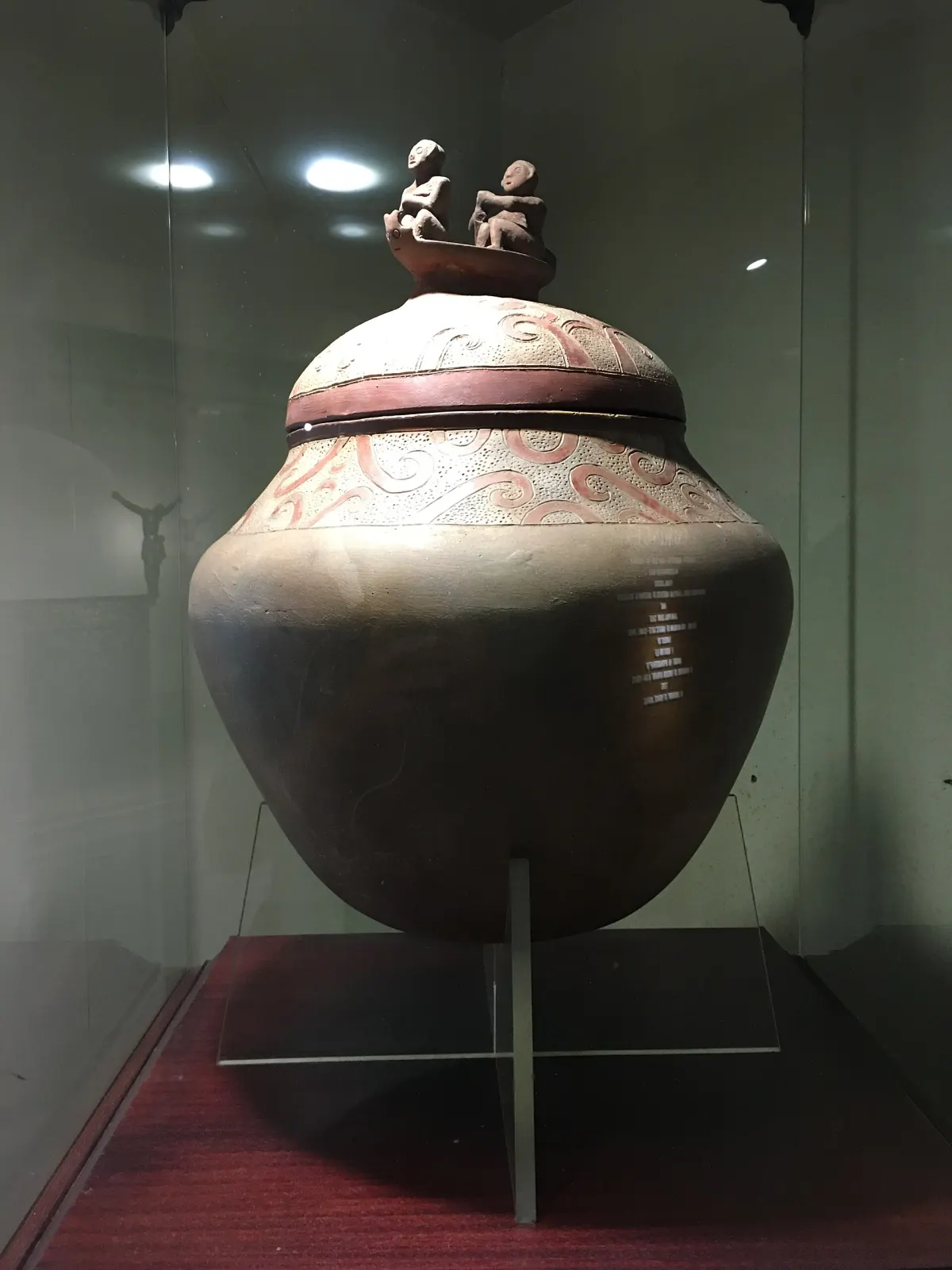
The Manunggul Jar belongs to another time
The celebrated burial jar with two figures in a boat is associated with the wider complex, but it comes from Manunggul Cave. Its place and period should remain distinct from the much older human fossils.
The Cultural Center of the Philippines’ encyclopedia entry dates the Manunggul Jar to approximately 890–710 BCE and describes its use in secondary burial. The boat on the lid is interpreted in relation to a journey after death. This is an archaeological interpretation of a carefully made object, not a transcript of a belief explained by the people who created it.
The jar demonstrates why prehistoric history should not be presented as a blur of everything before written records. Tens of thousands of years separate the older Tabon evidence from the jar’s period. Placing them in one paragraph without dates can create the false impression that they belonged to the same household or way of life.
The photograph accompanying this story shows the jar on museum display. A visitor should not expect to find that display object waiting inside the cave where it was excavated.
Tabon is important without being the beginning of everything
Other discoveries have changed the wider Philippine picture. A 2019 paper in Nature described Homo luzonensis from Callao Cave on Luzon, based on remains assigned to a distinct human species. The research included a foot bone previously dated to about 67,000 years ago.
Callao and Tabon are different sites on different islands, with different fossil evidence. The discovery on Luzon is not a reason to dismiss Tabon. It is a reason to abandon an overly simple national origin story in which one find must carry the whole burden of being first.
Prehistoric populations also lived long before the modern Philippine state and its present categories of citizenship. Describing someone as the first Filipino may be convenient shorthand, but it can hide both that distance and the uncertainty in the record. More exact language gives the reader a better history.
Visiting as a reader of evidence
Begin with the National Museum’s Tabon Caves Area Museum and satellite office for current registration, permits and access guidance. The museum’s site information describes a road and boardwalk approach; old accounts treating a boat as the only way to reach the complex should not be assumed current.
Confirm which caves are open, whether a guide is required and what the route involves. Ask about steps, slippery surfaces and any restrictions relevant to children or mobility needs. Do not collect stones, disturb deposits or remove material that looks unimportant. An object’s position can be part of its evidence.
Allow time for the museum as well as the landscape. Labels and explanations can help separate a human fossil from an animal fragment, a tool from an ordinary stone, and one archaeological period from another. Those distinctions are the difference between seeing a cave and understanding why it matters.
Tabon rewards a patient kind of curiosity. Its deepest stories do not arrive complete. They emerge through careful comparison, acknowledgment of uncertainty and attention to traces that might otherwise be overlooked. The Philippines’ deep past becomes more compelling when we allow the evidence to remain that rich.
Explore more Philippine history.
Reporting note: This AI-assisted feature synthesizes the linked museum records and research, checked November 6, 2026. It is not a report of new excavation or an eyewitness visit. Dates are estimates where indicated; current visitor arrangements should be confirmed with the National Museum.
Join the conversation
Sign in to comment